Jarosite vs. hematite vs. goethite: telling them apart in SWIR imagery
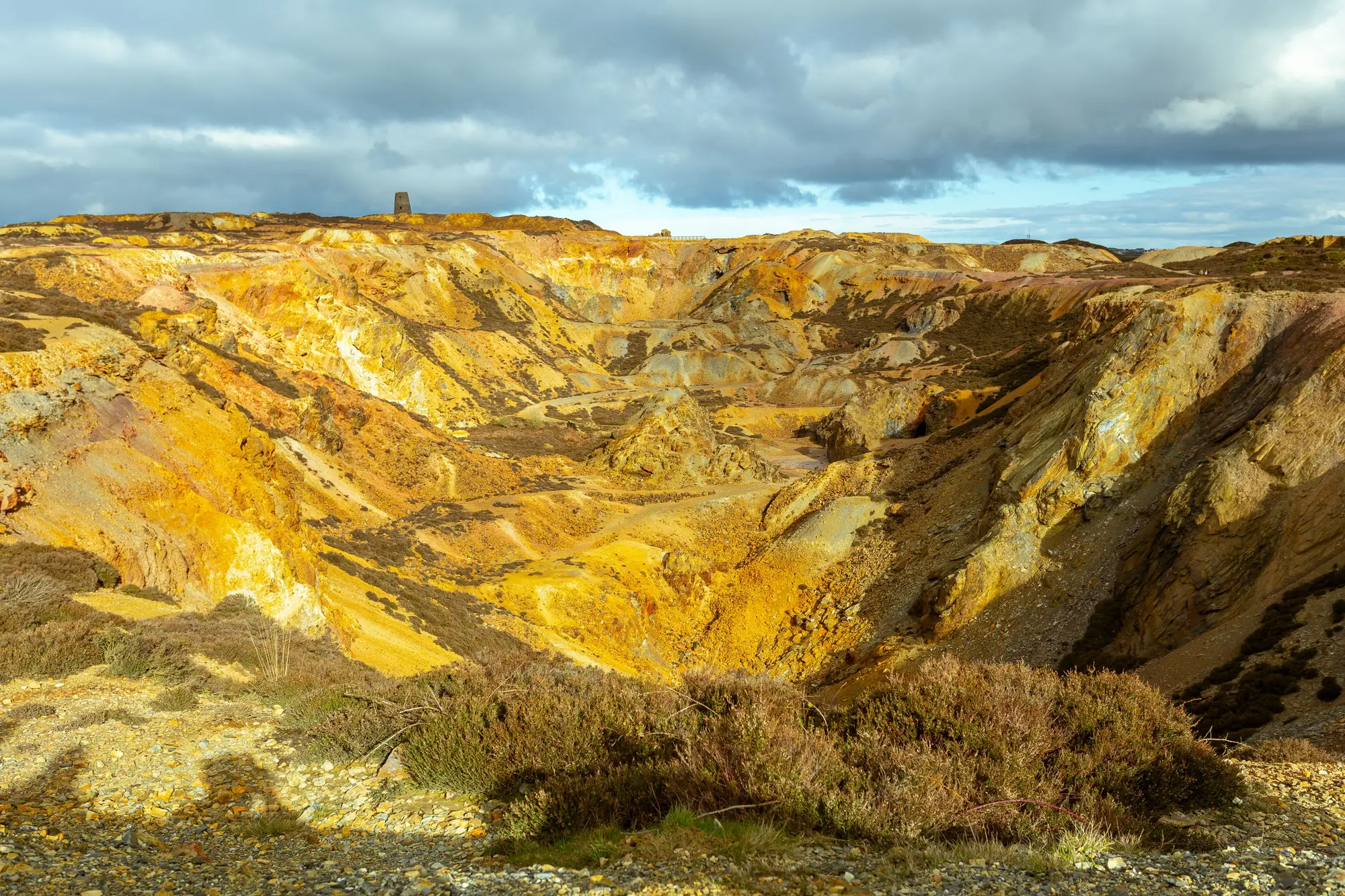
You're standing on a ridge with a chunk of rusty float in your hand, trying to decide if it's hematite-stained, goethite-rich, or carrying a jarosite rim from an old acid-sulfate event. The hand lens tells you it's red-brown. It doesn't tell you which iron mineral is doing the coloring, and in a gossan that distinction is the whole ballgame. A spectrum resolves what color alone can't.
Where the ferric absorption actually sits
Hematite and goethite both owe their red-brown palette to a crystal field absorption from Fe3+, but the two minerals don't put that absorption in the same place. Hematite centers it around 860-880 nm. Goethite shifts it longer, broader, typically 900-950 nm. That's a narrow window to argue over, and it sits right at the VNIR-to-SWIR1 boundary, not deep in the 2.2-2.3 micron range most people think of when someone says "SWIR clays." Sensors and flight configurations that resolve that edge band are the ones that split hematite from goethite cleanly. Drop your coverage before 900 nm and you're back to guessing from color.
Jarosite plays an entirely different game
Jarosite's diagnostic feature sits outside that ferric window entirely, in a sulfate-hydroxyl combination absorption near 2265 nm, usually paired with a shoulder near 1850 nm. That 2265 nm position sits uncomfortably close to kaolinite's feature around 2200 nm and alunite's paired absorptions near 1480 and 2170 nm, so eyeballing a single band almost never settles it. Continuum removal and band-depth comparison across that range do the actual separating. Jarosite typically still carries a shallow ferric dip near 900 nm underneath, which is why a jarosite pixel can look like it's hedging between iron oxide and clay. It's doing both.
Limonite isn't a mineral, and the spectrum doesn't pretend otherwise
"Limonite" is a field term, not a mineral species. It covers whatever mix of goethite, hematite, and amorphous ferric oxide happens to be coating the rock. A hyperspectral pixel over limonite-stained gossan is almost always a mixed spectrum, and the dominant endmember shows through in the position of that ferric absorption minimum. Short and sharp, around 860-880 nm, points hematite-dominant: usually more oxidized, often a more mature cap. Shifted long, 920-950 nm, with a real water or OH shoulder developing between 1400 and 1900 nm, points goethite-dominant: often younger, more actively oxidizing, sometimes tracking fractures where groundwater is still moving.
None of this is academic. Jarosite commonly marks the leached cap sitting over a sulfide-rich supergene blanket in porphyry and epithermal settings, the kind of horizon you want your collar sited against, not drilled through blind. Hematite-dominant limonite can mean the system has gone cold and fully oxidized. Goethite rims on fractures can mean oxidation is still working its way down. Three iron minerals, three different stories about where you are in the weathering profile, and a field spectrometer reading at one outcrop won't tell you how that zonation moves across the ridge.
That's the gap a wide-swath hyperspectral pass closes. A PIMA or ASD gives you a point. Walking the whole tenement with one gives you the pattern, the way a jarosite halo wraps around a core of propylitic or phyllic alteration before it fades into goethite-stained float at the margins. That pattern is often more diagnostic than any single pixel's exact mineralogy, and it's the thing you can't see standing at any one outcrop.
If you're trying to turn that kind of zonation into a target before the rig mobilizes, a campaign-wide alteration map built on exactly this clay, carbonate, and iron-oxide signature work is worth a look.