Skarn alteration signatures in SWIR hyperspectral imagery: what shows up
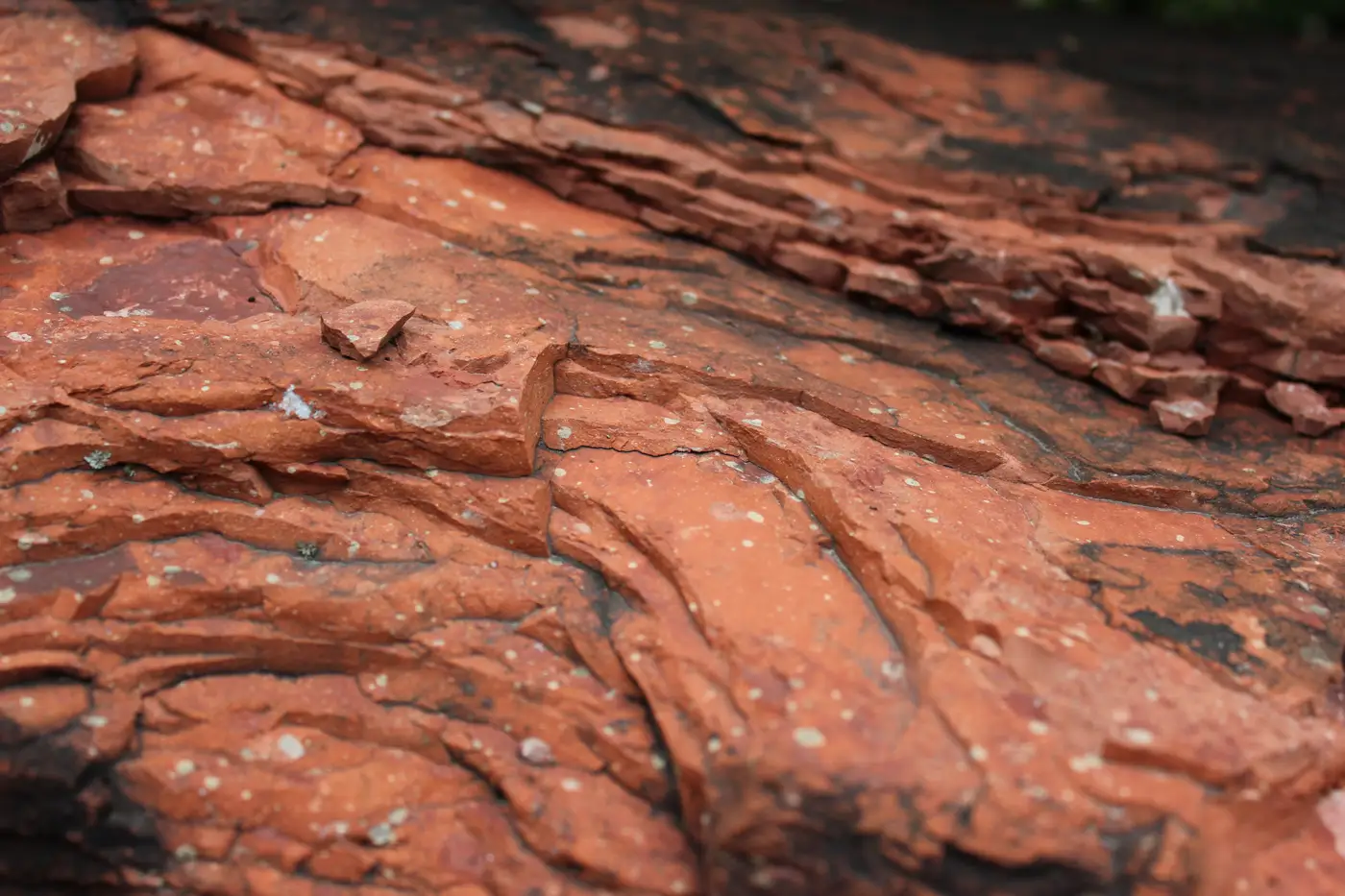
Skarn deposits are a bit of a spectral trap. The minerals that define them in hand sample, garnet and pyroxene, are close to invisible to a SWIR sensor. The minerals that light up a hyperspectral cube are the ones that formed afterward, during retrograde alteration, once the system cooled and hydrothermal fluids reworked the prograde assemblage. If you're vectoring a drilling campaign off a wide-swath pass over a skarn target, that split matters more than the deposit model does.
Why garnet and pyroxene don't show up
Grossular-andradite garnet, diopside-hedenbergite pyroxene, wollastonite: these are the textbook prograde calc-silicates, and they're anhydrous. No OH in the lattice, no CO3, nothing in the 2.0-2.5 micron range for a SWIR detector to grab onto. Run continuum removal across a garnet-pyroxene skarn core and you get a flat line, because the minerals simply don't have a diagnostic absorption feature to offer. That's normal for the mineralogy. It's not a processing error and it's not a gap in coverage.
What does show up is the retrograde overprint. Actinolite and tremolite carry a Mg-OH feature near 2320 nm. Epidote and chlorite cluster features around 2250 and 2340 nm. Where the system has seen meteoric water and sulfide oxidation, clays (illite, muscovite, montmorillonite) give the classic Al-OH doublet near 2200 nm, and iron oxides (hematite, goethite, jarosite) mark out gossan at the surface. Carbonate reflux along the marble front, calcite and dolomite recrystallizing, produces a strong CO3 feature around 2330-2340 nm that sits close enough to the actinolite feature to need careful separation in a spectral library, not a glance at a single band ratio.
Exoskarn vs endoskarn: where the response diverges
Exoskarn develops on the carbonate side of the contact, where the pluton's fluids replace limestone or dolostone. Endoskarn develops inside the intrusion itself, worked from the inside out by the same fluids. Both can carry a garnet-pyroxene core that reads flat in SWIR. The retrograde overprint partitions differently across the contact, and that partitioning is what a hyperspectral pass can resolve even when the prograde core stays silent.
Exoskarn tends toward a tighter, more carbonate-rich retrograde signature: calcite-dolomite flooding the marble front, epidote and chlorite developing where garnet has broken down, occasionally a thin talc-serpentine fringe if the wall rock was dolomitic rather than calcitic. Endoskarn sits in a more aluminous, more silica-rich host, so the overprint usually runs stronger toward clay and sericite, illite and muscovite picking up along fracture networks and feldspar breakdown, closer to a phyllic signature than anything carbonate-hosted.
Neither pattern is something you'd stake a hole on alone. Across a tenement-scale pass, though, the asymmetry holds up often enough to be useful: a garnet-pyroxene core bounded by a tight carbonate-epidote halo on one flank and a broader clay-iron oxide halo on the other is telling you which side of the contact you're standing on before anyone has logged a thin section.
Reading the zonation as a vector
The retrograde halo isn't random. It zones outward from clay and iron oxide at the margins, through chlorite-epidote-carbonate, into a tighter actinolite-tremolite fringe, down to the spectrally silent core you have to infer from what surrounds it. Mapped across a wide-swath hyperspectral pass, that zonation reads as a set of concentric rings you can walk a drill program toward, narrowing from the outer clay-oxide signature through the calc-silicate fringe to wherever the SWIR signal goes quiet. That quiet patch, more than the bright pixels around it, is usually where the garnet-pyroxene core sits, and where any ore-stage overprint tends to concentrate.
It's also why a skarn target rewards a full-tenement first pass rather than a handful of outcrop traverses. A ridge-line exposure might show you epidote and actinolite on one face and nothing on the next, with no way to tell from the ground whether that's a real break in the halo or just where the rock is covered. That's the gap a campaign-wide alteration pass is built to close, fingerprinting clay, carbonate and iron-oxide signatures across the whole area before a single traverse gets walked.
If a skarn target is next on the drill queue, it's worth seeing the halo in full before picking the first hole.