What is a leached cap in porphyry exploration?
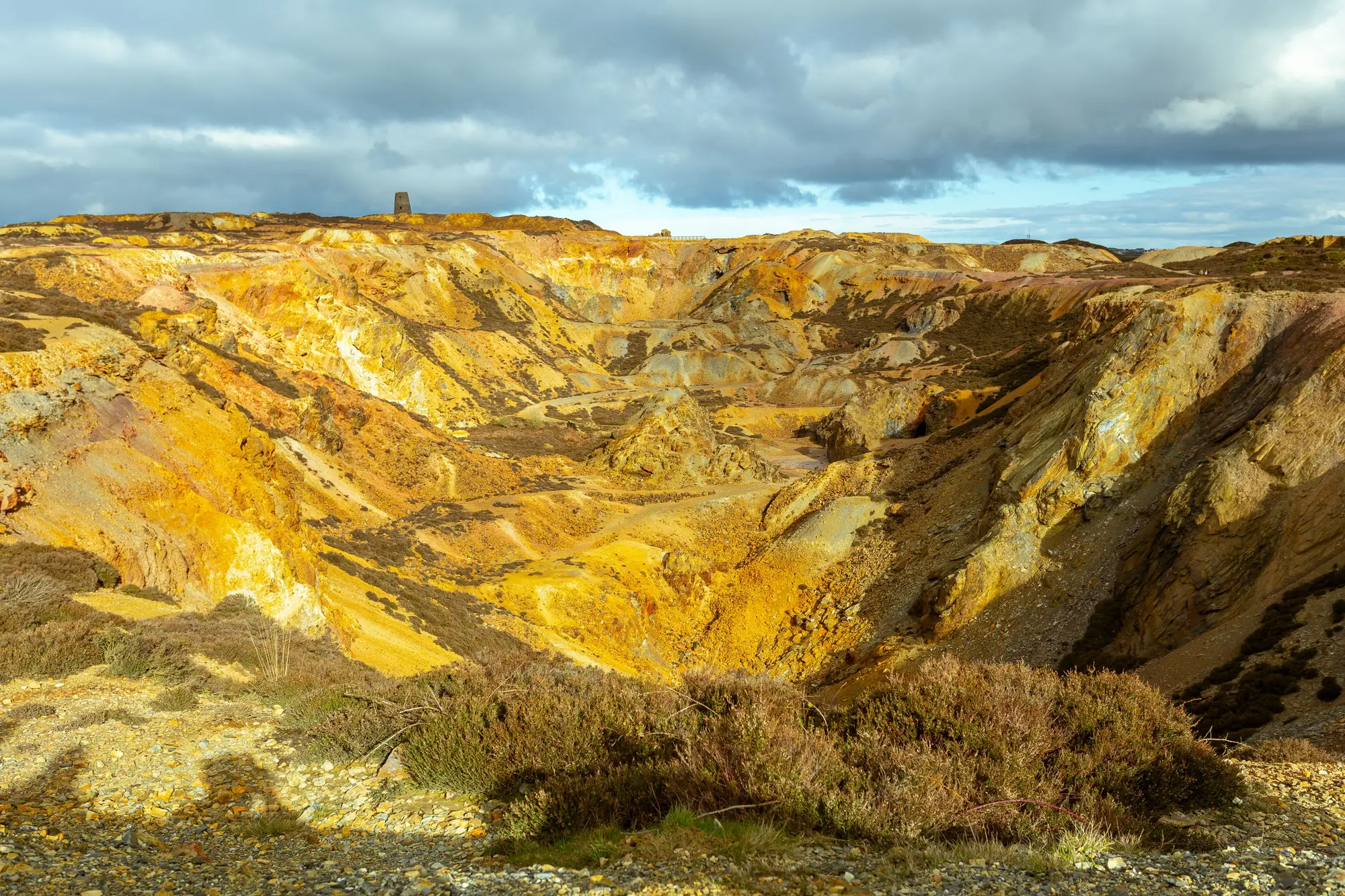
A leached cap is the rusty, bleached-out rind that sits on top of a porphyry system where sulfides used to be. Pyrite and chalcopyrite near surface oxidize, the sulfuric acid they generate strips the base metals out, and what's left behind is a mix of iron oxides, residual quartz, and clay. No copper to speak of in hand sample. Plenty of hematite, goethite, and jarosite staining the rock orange, red, and straw-yellow. If you've walked a porphyry district, you've stood on one.
The reason the leached cap matters more than its copper grade suggests is that it's a signpost. It tells you sulfides were there, they got oxidized, and the metal they held went somewhere. Usually down.
Leached cap vs gossan
People use these terms loosely in the field and it causes confusion on section. A gossan, strictly, forms over a massive sulfide body, something like a VMS deposit, where the whole rock was sulfide-rich and oxidation leaves a near-total iron-oxide residue, often boxworky and spongy because so much volume got removed.
A leached cap forms over disseminated and stockwork sulfide in a porphyry, where sulfide content was maybe 2 to 8 percent of the rock by volume rather than near-massive. The host rock fabric, the quartz veining, the original alteration mineralogy, all of it mostly survives. What you're reading on surface is a leached porphyry system: diffuse sulfide scattered through a large volume of altered rock, now oxidized in place. Same oxidation chemistry as a gossan, different starting material, different texture on the outcrop.
Geologists who've worked both settings will tell you a gossan often has a spongier, more vuggy look because there was more sulfide to remove. A porphyry leached cap tends to preserve more of the original rock texture, with the iron oxide riding along fracture surfaces and old vein walls rather than replacing the whole mass.
Reading the boxwork
Boxwork is the lattice of iron-oxide walls left standing after the sulfide grain they once surrounded got dissolved out, leaving a cavity or vug framed by a thin rim of limonite. It's one of the more diagnostic textures you can log, because the shape and spacing of the boxwork cells often mirrors the original sulfide habit.
Fine, tight boxwork with small cells usually points back to disseminated pyrite. Coarser, blockier boxwork with bigger cavities can mean you had coarser sulfide clots or a vein stage with chalcopyrite and bornite mixed in. Limonite color is worth logging too: goethite runs more yellow-brown, hematite runs red, jarosite sits pale yellow and tends to form where the leaching ran hardest and longest. None of this gives you a grade. It gives you a vector, a sense of where the sulfide was richest before it left.
What's sitting underneath: the supergene blanket
The part that moves a drill program is what happens next. The copper that got stripped out of the leached cap didn't vanish. Acid groundwater carried it down until it hit the water table, where conditions shift from oxidizing to reducing, and the copper redeposits as secondary sulfides, mostly chalcocite, coating or replacing the original hypogene pyrite and chalcopyrite grains. That zone is the supergene enrichment blanket, and in a lot of the classic porphyry districts it's where the bulk of the mined copper sat, grades several times richer than the primary hypogene ore below it.
A thick, well-developed leached cap with strong boxwork and a clear limonite zonation is often the surface expression of a system that had time and the right chemistry to build a real blanket underneath. A thin, patchy cap with little boxwork might mean erosion stripped the blanket away already, or the system never had the volume of sulfide to generate much enrichment in the first place. Reading the cap correctly, before a single hole goes in, is most of the argument for where you site your first fence.
That's the catch with leached caps on a wide tenement. The iron-oxide mineralogy that tells the enrichment story and the clay alteration that frames the whole hydrothermal footprint are both spread across ground no field crew traverses end to end in one season. A SWIR-based alteration pass over the full area, built from wide-swath hyperspectral imagery, is what Mineral Mapping exists to put in front of you before you plan the grid. Worth a look if your next campaign still needs a first-pass vector.